Self-defense is not just about defeating an aggressor.
It must be prefaced: the most important aspect of defense is prevention. Depending on the aggressor’s proximity, lessons at UMA teach students pre-fight strategies and different methods of psychological, verbal, & physical defenses to use. In regard to a student’s ability to defend himself or herself, I’m not so much concerned with building up confidence as I am in reinforcing students’ sensibility; sensibility about how they ensure their own personal safety.
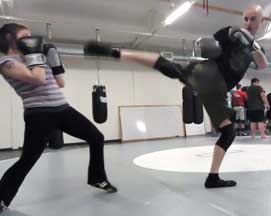
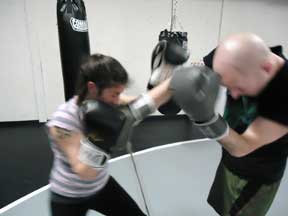
The UMA program addresses all ranges of combat.
Weapons Range: Training begins with a stick which correlates to many improvised weapons.
Kicking Range: The longest personal physical tool available to reach your target: legs & feet.
Punching Range: The next longest personal physical tool available: arms and hands.
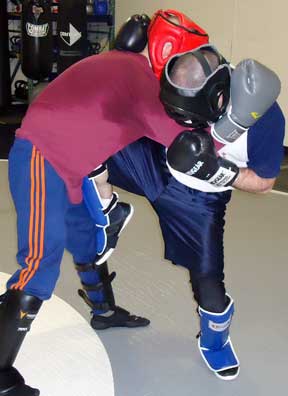
Close Quarters Range: Punches and kicks are cramped and you must rely on knees, elbows, head butts. Close quarters is the range at which you can pin the opponent’s limbs to nullify the attack, and at which the clinch position occurs. Joint locks also can be taken at this range if the opportunity arises.
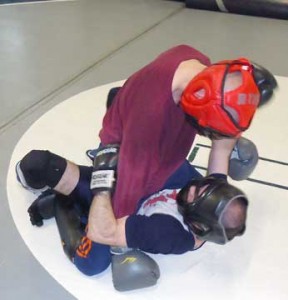
Grappling Range: Where you engage in wrestling and submission fighting, which typically winds up on the ground. Aspects of grappling can begin on the feet.
At UMA we offer training for the holistic martial artist.
A complete Fighter (i.e. martial artist) is skilled in striking, grappling, throws/takedowns, and submissions. In order to have this skill set we work three modes of combat:
Out-Fighting: before the clinch.
Consists of stance, movement, strikes, shoots, defense, and combinations. Primary goal is “stun-n-run,” or the knockout.
In-Fighting: after the clinch, while still standing.
Consists of the clinch, strikes, throws/takedowns, and defense. Primary goal is the knockout or devastating takedown ending in a control position.
Ground-Fighting: combat after you hit the floor.
Consists of positions, strikes, submissions, transitions, and defense. Primary goal is knockout or submission.
The UMA curriculum distinguishes between sport-effective & street-effective technique.
The primary difference on the street is that there are no rules, and you have no guarantee it will be one-on-one. Some schools (or should I say some programs) are characterized by a litany of techniques. These techniques are introduced to the student at progressive levels, however these levels may have no real connection or relation. Perhaps they are categorized by level of difficulty.
For example, “At this level, you will learn these 5 blocks, and these 2 kicks, and this fighting pattern.”
“At this level, you will learn these 2 blocks, these 3 strikes, this fighting pattern, and this partner drill.”
Instead of taking the totality of a system and dividing it into equal slices to serve the student over an imposed time-period, UMA prefers to teach based on the orientation of situations. That way the student isn’t having to digest what is equivalent to “combo-platter” meals from a “menu-style” checklist.
Allow me to clarify:
How many different ways do you think an unarmed assailant can attack you? You might think, “There are thousands of different ways someone can attack.” If that were the case, by listing some common ones we should come up with a hundred pretty quick, right? Well, let’s see… a two-hand shove, a round kick, a hay-maker, a straight punch, a front kick, a tackle, a choke, an uppercut, a heel stomp, an elbow strike… After a few minutes more we will start running low on different methods someone can INITIATE an attack.
Within these examples you might see several shared commonalities. That is to say, some elbow strikes and hook punches and round kicks all travel in the same “line of fire.” Therefore, we don’t have to spend time segregating which defensive maneuver should be applied to each individual type of attack. There are simple options that can take care of a majority of beginning attacks without devising levels of intricate step-by-step procedures for the student to memorize. This is a reality that is incorporated in to the UMA curriculum.